The Dill Autonomy Engine
The hybrid AI architecture behind every Pickle Robot
AI is limited by proprietary warehouse data
Learn how we unlock that data
The Dill Autonomy Engine [DAE] is Pickle’s hybrid autonomy architecture for Physical AI. It combines classical optimal control with generative AI and targeted human input.
DAE solves one problem: how do you get a robot to learn a hard physical job fast enough that customers don’t give up on it? In warehouses, the training data isn’t on the internet. Most examples are learned in the field. DAE is built so a robot deploys at useful performance immediately and improves as it learns. Will be available to license by other Physical AI providers.
The hybrid architecture uses classic model control to harness a generative AI core that is sandwiched between a guidance layer and a guardrails layer.
How DAE works
Fusion of Generative AI Harnessed by Model-based Optimal Control Methods
The Dill Autonomy Engine's center is a three-layer architecture. Optimal control on the outside; generative AI in the middle.
Guidance Agent
Generates kinodynamically valid, collision-free motion plans against multiple planning constraints including system and customer KPIs such as speed, eligibility, and workflows.
Skills Agent
A diffusion policy fine-tuned on production data so that Pickle Robots learn from experience. Conditions on the Guidance plan and adjusts for contact-rich manipulation and the partial observability of the open world. Handles the messiness classical methods can't model.
Guardrails
Independent safety layer separate from the generative model. Enforces hard no-go conditions on the actuator commands before they reach the robot. The robot cannot violate guardrails regardless of what the Skills Agent outputs.
The sandwich shape is intentional
The generative model has freedom to handle open-world variability, harnessed by two deterministic layers that keep the system safe and predictable.
The harness provides structure
DAE’s harness is the engineering scaffolding that makes the generative core data-efficient enough to deploy:

Sensors and Actuators
Multiple cameras feed real-time perception. The system maintains a continually updated world model of the trailer interior, the freight, and the gripper. The world model is consumed by every agent to the optimal control elements.

Observer Agent
Classifies robot behavior as good or bad against customer KPIs (trailer unload time, package rate at the conveyor) rather than abstract machine learning metrics. Routes the right examples back into training. The Observer is also where DAE links to process-intelligence systems.

Supervisor Agent
Arbitrates between autonomous action, safe quick actions, and calling for help. Manages the robot’s performance mode in response to Observer signals.

Teleoperation interface
Injects human intelligence at the specific moments the Skills Agent makes a bad choice. Corrections are captured as on-policy training data and used from there. Teleoperation runs through the Guidance Agent so the system handles the kinematics gap between human operator and KUKA arm.
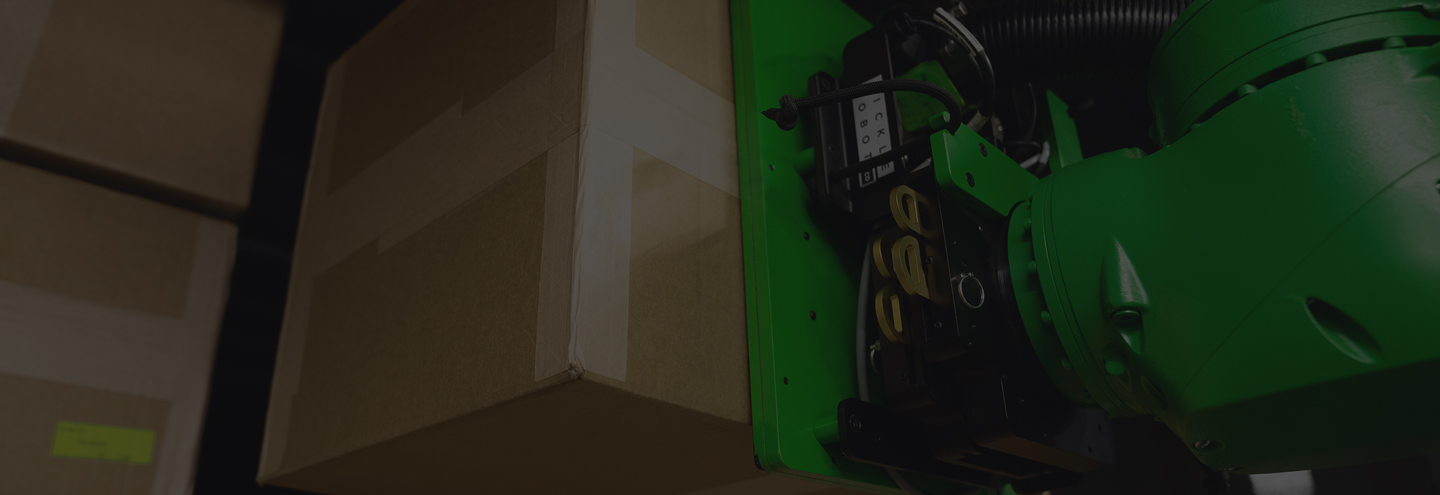

UPS Communications
“UPS is using Pickle Robot’s unloading technologies to ease the challenging job of unloading trailers, making the role less physically demanding for employees, and delivering better package care and reliability for UPS customers.”
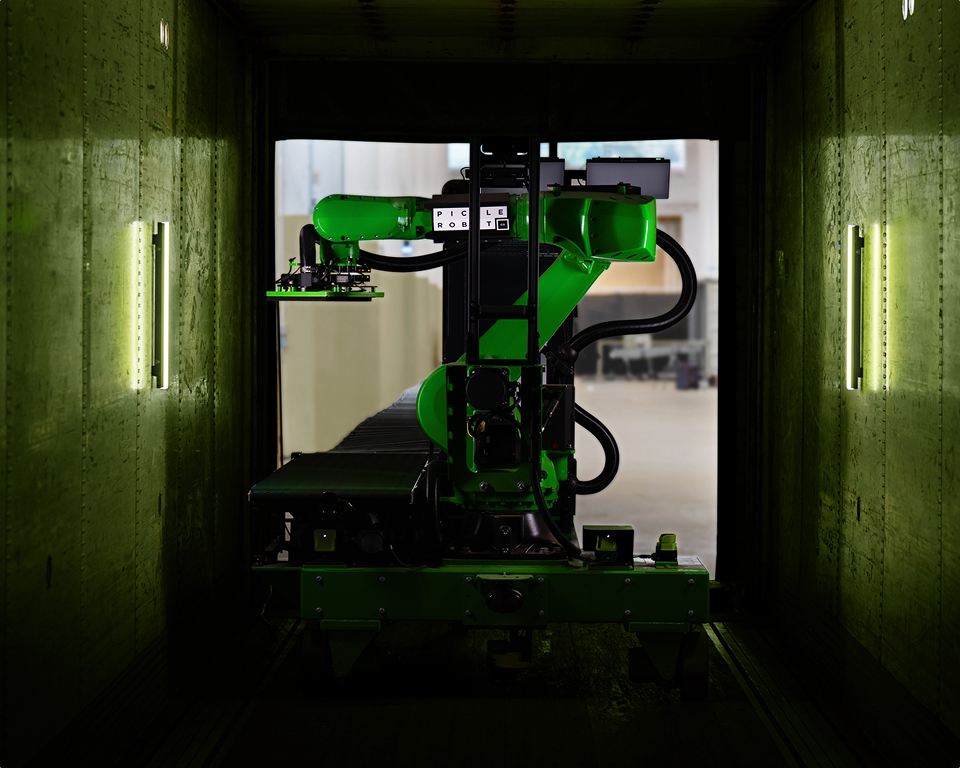
The Pickle Robot
Reliably unloads trailers and containers of non-palletized goods in as little as 90 minutes.
FAQ
DAE is Pickle’s hybrid autonomy architecture for physical AI. The center is the model control sandwich: optimal control on the outside, a diffusion-policy generative AI on the inside. Around the sandwich sits a harness of sensors, observer and supervisor agents, guardrails, and a teleoperation interface that route on-policy data back into training.
The architecture that sits at the center of DAE. A Guidance Agent (optimal control) generates fast, deterministic motion plans. A Skills Agent (a diffusion policy) refines those plans for contact-rich, open-world manipulation. A Guardrails Agent enforces an independent safety layer underneath. The shape is intentional: generative freedom in the middle, deterministic constraints on the outside.
There are three ways to get intelligence into a robot. You can model the physics mathematically, you can simulate millions of hours of practice, or you can teach it through human demonstration. We tried all three. None of them worked well enough on their own.
.png)
Most VLA and foundation-model approaches bet on a bigger, smarter model to handle the open world. DAE bets on hybridization. Optimal control delivers reliability and the five planning constraints (kinodynamic, metal-on-metal collision-free, package collision-free, attachment, task cycle time). Generative AI handles contact-rich manipulation in regions the world model can’t represent cleanly. Together they hit production-grade reliability without an internet’s worth of training data.
No. The Guidance Agent gives the robot a strong starting point from day one. The Skills Agent refines from there, fed by on-policy data captured during real shifts and labeled by the Observer Agent.
Guardrails are an independent agent separate from the generative model. Regardless of what the Skills Agent outputs, the Guardrails Agent enforces no-go conditions on actuator commands before they reach the robot. The long-term path is mathematical safety guarantees that change the cost of installing industrial robots in warehouses.
DAE is designed with the long-term goal of running across multiple embodiments. Will be available to license by other Physical AI providers.